

What Should Your Commercial Floor Care Plan Include Before Fall in Charleston?
Why Charleston buildings should review floor care before fall starts
A lot of commercial properties in Charleston put off reviewing their floors until it is too late.
During summer, it is easy to overlook floor issues. Dry weather, less dirt on some days, and regular cleaning can make floors seem fine, even if the maintenance plan is not strong enough. But when the season changes, traffic patterns shift, moisture appears more often near entrances, debris spreads further inside, carpet lanes darken faster, and hard floors start to look worn sooner than you might expect.
That is why it is important to review your Charleston commercial floor care plan before fall, instead of waiting until tenants or visitors notice signs of wear.
For property managers, facility managers, and office decision makers in Charleston, floors are more than just surfaces. They help create first impressions, affect how clean the building feels, and often lead to complaints in lobbies, corridors, entryways, and shared spaces. If your floor care plan is too basic, signs of wear usually show up near the front door first.
Start with the floor types in your building
A good Charleston commercial floor care plan starts with a simple question: which floor surfaces do you need to protect?
This might seem obvious, but many buildings still treat every floor the same. That is often where problems begin.
For example, a Charleston office building might have carpet in private suites, VCT in workrooms or service areas, resilient flooring in corridors, and hard surface flooring in the lobby. Each surface handles traffic and dirt differently, and each one shows wear in its own way.
In most commercial buildings, here is what that looks like:
- Carpet holds dry soil, fine grit, and traffic-lane buildup.
- VCT loses shine quickly when the finish gets thin or uneven.
- LVT and similar surfaces can look dull even when they are technically clean.
- Tile and grout tend to show tracked soil fastest near entries and restrooms.
- Concrete and other hard surfaces often wear first at transitions, not just in open areas.
Before fall, make sure your Charleston commercial floor care plan lists every major floor surface in the building and matches each one with the right maintenance method.
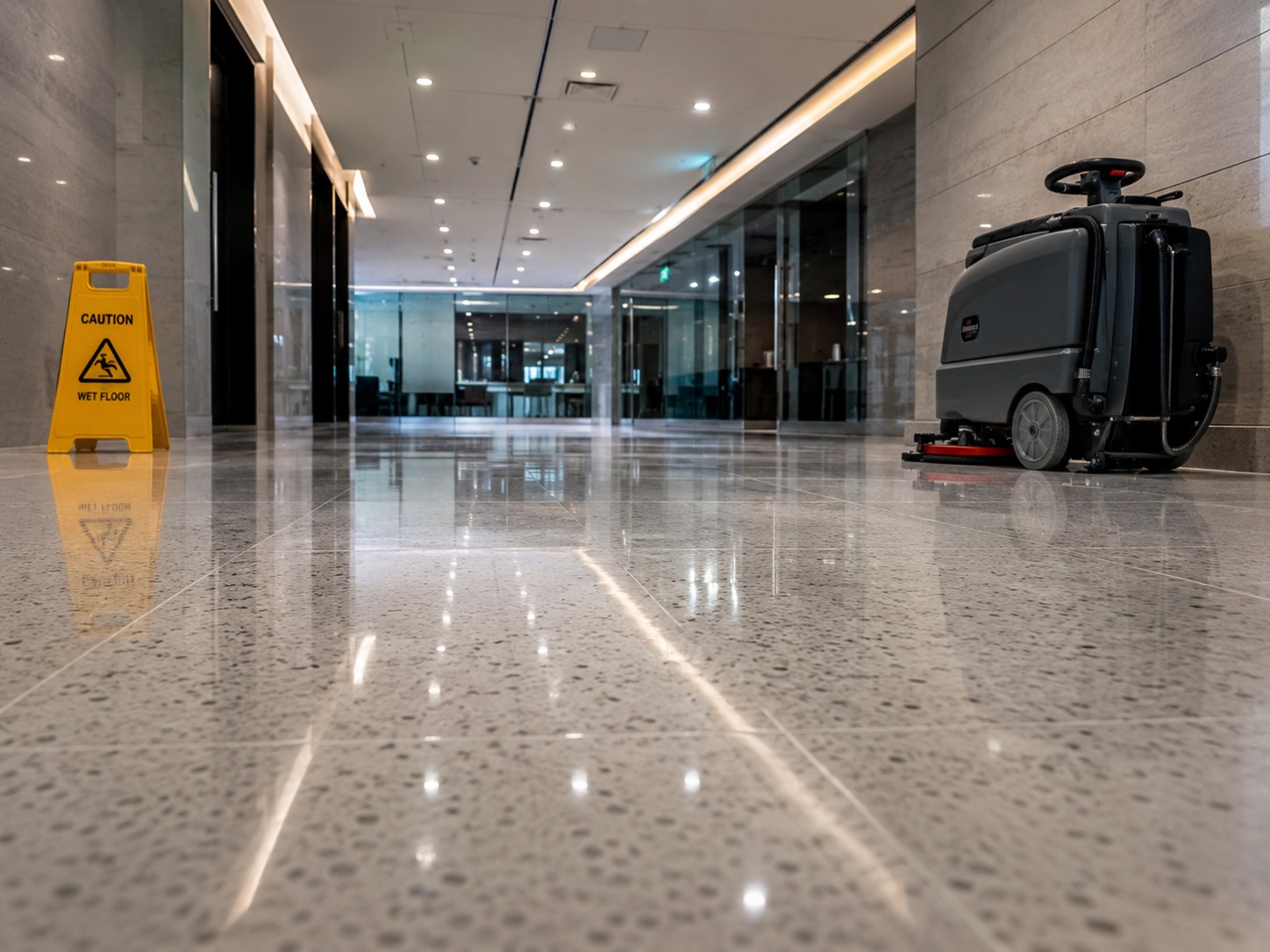
Entry protection should be the first thing you review
If your entry strategy is not strong, the rest of your floor care program will have to work harder than necessary.
Most floor problems begin at the threshold. Dirt and moisture come through the front entrance, then move farther into the building through shoes, carts, deliveries, and visitor traffic. Once that happens, even a decent nightly routine can start falling behind.
That is why a good Charleston commercial floor care plan should include entry protection, not just regular cleaning.
For Charleston properties, this should include reviewing:
- Mat coverage at primary entrances
- Whether mats are still in good condition
- Whether mats are long enough to slow down soil transfer
- The floor condition just inside the door
- How often vestibules and front corridors are cleaned
If the first ten to twenty feet inside your building already look dull, have residue, or show visible wear, your entry protection probably is not strong enough.
Carpet care should focus on traffic lanes, not just open areas
Carpet rarely wears out evenly.
It usually starts to wear out in the same spots: main walkways, paths to elevators, hallways outside tenant suites, reception areas, and spaces near breakrooms. These areas often look gray, flat, or worn before the rest of the carpet.
A good Charleston commercial floor care plan should treat these high-traffic lanes as priority areas.
That means asking:
- Are high-traffic carpet areas being vacuumed often enough?
- Are edge areas being cleaned, or only the center of the room?
- Is spot treatment happening early enough?
- Does the building need low-moisture cleaning or extraction before fall traffic increases?
If you are not sure about the answers to these questions, your carpet care strategy is probably just reacting to problems instead of preventing them.
This is important because once traffic lanes get dark, tenants and visitors often think the whole building is less clean, even if the rest of your cleaning routine is working well.

Hard floor maintenance should be planned, not improvised
Hard floors are often where buildings start to lose their good appearance without anyone noticing right away.
The problem is not always visible dirt. Sometimes it is a loss of shine, uneven gloss, dull walkways, or scuff marks near entrances and shared corridors. For VCT, this often means the floor needs more than just regular mopping. For LVT or similar surfaces, it might mean the cleaning method is not bringing back the floor’s appearance as it should.
A good Charleston commercial floor care plan should spell out what needs to be done daily, weekly, and on a periodic basis.
For example:
- Daily work may include dust mopping, spot mopping, and extra attention at entries.
- Weekly work may include deeper edge work and machine scrubbing in select areas.
- Periodic work may include burnishing, scrub and recoat, or strip and wax depending on the surface and condition.
The goal is to avoid waiting until the floor looks worn out before scheduling repairs. By that point, the building has already lost some of its visual appeal.
Restrooms, breakrooms, and transition zones need their own floor strategy
Some of the worst-looking floors in a building are not in the lobby, but in the areas between main destinations.
Consider the floor outside the restrooms, the path from the breakroom to the office, or the hallway from the elevator to tenant suites. These spots often collect moisture, paper dust, tracked-in debris, and food residue faster than most managers realize.
That is why your Charleston commercial floor care plan should list transition zones as priorities, not as afterthoughts.
These are the spots where:
- Mop lines begin to show
- Corners collect debris
- Finish wears down early
- Slip risk can increase
- Complaints about dirty floors usually begin
If your team only checks the center of the lobby or open office areas, they might miss the spots where floor care is really falling behind.
Inspections should look at wear, not just cleanliness
Floor inspections often stop at one question: does the floor look clean?
That is not enough.
A better inspection asks:
- Is the finish still protecting the surface?
- Are traffic lanes appearing too early?
- Is one floor type getting the wrong level of service?
- Are entry areas holding up between visits?
- Are mats doing their job?
- Are corners, edges, and transitions being maintained consistently?
This is how a Charleston commercial floor care plan stays effective. It moves from just focusing on looks to planning based on the actual condition of the floors.
For Charleston property managers and facility teams, this means fewer surprises, better timing for floor maintenance, and fewer last-minute requests before tenant visits, walkthroughs, or complaints.
What your Charleston floor care plan should include before fall
Before fall traffic increases, your Charleston commercial floor care plan should clearly address five things: floor types, entry protection, carpet traffic lanes, scheduled hard floor maintenance, and inspection priorities for transition zones and shared spaces.
A plan like this helps a Charleston building keep its good appearance as traffic, moisture, and dirt increase. It also makes it easier to budget, schedule service at the right time, and avoid waiting until floors look worn before acting. If your property already shows wear near entrances, corridors, or shared spaces, a facility walkthrough can help you identify problem areas and determine where your Charleston commercial floor care plan needs improvement before fall makes those problems worse.
